Naples Development Capital & Capacity Radar · Public reading · Records-only, evidence-status labeled
Naples Development Capital & Capacity Radar
Who Is Building Naples — and What Does It Demand from Collier County?
Nineteen active projects, one dominant redevelopment, a county paying 2.4× the city into downtown — read from the public record, with every dollar kept in its own class.
As of July 17, 2026 · an Intelligence Desk publication produced by Barone Media Group · not legal or investment advice.
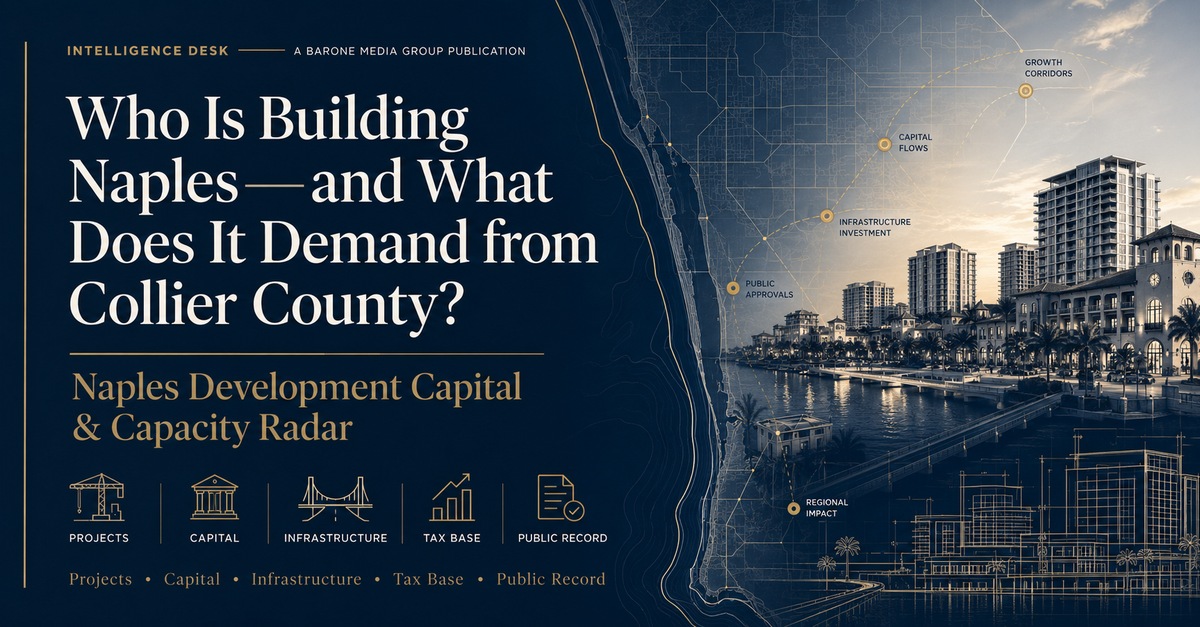
Editorial cover illustration. The map, skyline, and parcel lines are illustrative — not an authoritative GIS map, site map, or project rendering.
How to read this article. Every material claim carries one evidence status, applied strictly:
Verified primary/loaded source ·
Partially verified program verified, figures not ·
Reported secondary source, not independently verified ·
Modeled labeled arithmetic on verified figures ·
Needs source pull record exists, not yet retrieved. Nothing here is inferred as fact, and unlike kinds of capital are never summed.
01 · The QuestionWhat the record can actually answer
Naples does not lack for stories about growth. What it lacks is a version built only from what the public record can carry: the City's own site-plan register, the adopted redevelopment budget, the five-year capital plan, and the Florida Department of Revenue's tax rolls. Read together, those documents answer a narrower and more useful question than "how much money is coming" — they answer who is building, what has actually been approved, what kind of capital each dollar figure really is, and what the city's private pipeline demands from Collier County's public balance sheet.
02 · The PatternHospitality-led, mixed-use, Gulf-front and downtown
The City of Naples Site Plan Summary Report — the City's official register of active site-plan petitions, as of July 1, 2026, retrieved and re-verified from the primary PDF on July 17, 2026 — lists 19 active or recently-sufficient projects. Verified
The pattern is unambiguous: the pipeline is hospitality-led and mixed-use, concentrated on the Gulf front and along the downtown / Goodlette-Frank corridors. Of the top-ranked projects, most are hotels, resort amendments, branded residences, or club campuses; the balance is institutional and retail.
03 · Ranked PipelineThe radar's top ten, by Development Pressure Score
The Radar scores projects 0–100 on seven weighted dimensions (capital, scale, approval complexity, public-capital dependency, service demand, county spillover, permanence) with an explicit missing-data penalty — a heavily marketed cost claim cannot buy rank over a better-documented project.
#
Project
Petition
Program (record)
Score
Evidence
1
Naples Beach Club — Four Seasons
PD Ord 2019-14420
~125 ac; ~147 residences; ~100-ac golf; hotel open Nov 2025
91
Part. verified
2
Naples Dual-Brand Hotel (The Commons)
25-SP1
290 rooms; 188,039 sf; 8 stories; 4.45 ac
63
Part. verified
3
Moorings Park (CCRC expansion)
26-SP2 (PD)
+140 units to ~514; 83-ac PD rezone
56
Part. verified
4
The Viceroy
22-SP8
12 condos + marina; transient-lodging CU (4-1)
52
Reported
5
D Downtown Mixed-Use (Wynn)
23-SP5 / 25-DRB3
~45,000 sf mixed-use; ~$15M reported
51
Part. verified
6
Inn on Fifth Expansion
25-SP3
Downtown hotel/residences PD expansion
48
Part. verified
7
Harbour House
25-SP8
14 luxury residences; $17.5M reported acquisition
44
Reported
8
Revs Institute — Revs Reserve
25-SP7
63,800 sf storage + hospitality; 6.6 ac
42
Reported
9
Club at Naples Bay Resort — Amdt 1
22-SP7 (PD)
Resort/marina/club amendment (scope not pulled)
40
Needs pull
10
Royal Poinciana Country Club
25-SP12
Private-club clubhouse; sufficiency 3/30/2026
34
Part. verified
At the top sits the Naples Beach Club — A Four Seasons Resort: a multi-phase, ~125-acre coastal Planned Development (Ordinance 2019-14420) with an operating hotel that opened November 2025, a maximum of 147 approved residences PD-wide (reduced from 175 by Resolution 2023-15054 Verified), a ~100-acre golf course debuting in 2026, 104-plus acres in permanent conservation easement, restored public access to 1,000-plus feet of Gulf shoreline, and roughly 400 permanent jobs reported filled from ~20,000 applicants Reported. It ranks first — 91/100 — on verified physical scale, permanence, and approval complexity. It does not rank first because of its widely repeated "$1B+" price tag: that figure is a reported project value, sourced to the developer and business press, and remains Reported — not independently verified.
One large project is deliberately absent from the ranking. Metropolitan Naples / Mini-Triangle (Ascent + Aura, ~326 units, score 64 on the same model) sits in the Bayshore Gateway Triangle CRA, unincorporated Collier County — outside City of Naples jurisdiction. It is tracked as a county comparator and read only in the spillover analysis. Jurisdiction is a fact; blending jurisdictions to make a bigger number is not.
04 · Capital, ClassifiedWhat kind of dollar is that?
The most common failure in development coverage is additive: a reported construction cost, a land sale, a construction loan, and a public streetscape budget get summed into one headline "investment" figure. The Radar's rule is the opposite — unlike capital classes are never summed.
Figure
Project / scope
Classification
Evidence
$1,000,000,000+
Naples Beach Club / Four Seasons
Reported project value
Reported
$113,604,228
Aura construction loan (Metropolitan — County comparator)
Reported debt — not independently verified
No Clerk instrument retrieved
$17,500,000
Harbour House coop-site acquisition (June 2025)
Reported acquisition price — not deed-verified
No Clerk deed retrieved
~$15,000,000
D Downtown Mixed-Use
Reported project value
Reported
$0
Private cost verified from a primary financial record
Verified project cost
Verified gap
That last line is the honest center of the analysis: as of July 17, 2026, not one private dollar figure in the Naples pipeline has been reconciled against a recorded mortgage, deed, permit valuation, or audited disclosure. "$0 verified" is a documented gap, not a claim that no money is moving — the Collier Clerk deed and mortgage pulls are logged open items, never estimated.
05 · The Public LedgerWhat the city and county have committed — verified
The City's downtown Community Redevelopment Agency (550 acres, base-year 1993, sunset 2044) is budgeted to spend $15,284,000 in FY2025-26 capital, led by $8,854,000 for the 1st Ave S / 10th St / 12th St S stormwater-and-infrastructure phase and $3,000,000 for Naples Design District improvements. Verified — adopted CRA budget
The CRA's tax-increment revenue for FY2025-26 is $7,951,651 from Collier County (3.0107 mills) and $3,248,590 from the City (1.2300 mills) — budgeted tax-increment revenue, verified against the adopted budget. The County's contribution into the City's downtown CRA is 2.4× the City's own.Verified
The City's five-year CIP (FY2026-2030) totals $401,248,311, with $59.1M in the first year — water-sewer, stormwater, streets, seawalls, parks. Verified
FDOT items in the Collier MPO TIP touch the same corridors: $1,799,881 (US-41 / Golden Gate Pkwy intersection, construction), $1,188,222 (US-41 PD&E, 3rd Ave to SR 84), $5,300,000 (US-41 pavement reconstruction PE, Golden Gate Pkwy to 5th Ave S). Verified figures
The reviewed record contains no document attributing any of these general or corridor costs to a named private project — no developer reimbursement, impact-fee credit, or public-benefit commitment tying a CRA or CIP line to a specific development was found. Public capital in Naples is, on the current record, corridor capital: it raises the carrying capacity of the districts the private pipeline builds in. Verified gap
06 · Tax Rolls & TimingWhy public decisions move value before market reports register it
City of Naples taxable value: $40.98B (2025 roll, final-certified 2026-03-31, post-VAB), up 6.69% final-over-final from $38.41B in 2024 — roughly 25.4% of the countywide base Modeled. Verified — 2025 DR-408 certification
Collier County taxable value: $161.44B (2025 roll, final-certified 2026-03-31, post-VAB), up 6.18% final-over-final.Verified — 2025 DR-408 certification
County new-construction just value: $4.30B in 2025 — the highest in the DOR series back to 1997.Verified
The downtown CRA increment — $2.78B over a 1993 base of $183.8M — now equals roughly 6.8% of citywide taxable value. Modeled
The timing is the analytic point. The 2025 tax roll (final-certified 2026-03-31, post-VAB) assesses the January 1, 2025 condition of the ground and cannot contain the unbuilt pipeline: the Dual-Brand hotel, the Viceroy, Moorings Park's expansion, Harbour House and the rest are approvals-in-motion, not assessed improvements. Yet the public commitments that serve them — $15.28M of CRA capital this year, $401.2M of five-year CIP — are already adopted. Public capital is being committed ahead of the taxable value the pipeline would add.Modeled — timing comparison of verified figures; no project-level attribution made
Correction (2026-07-20): this section originally cited Florida DOR Data Book figures at the R-NVAB (pre-VAB) stage — City $41.29B (+7.5%); County $164.53B (+8.2%) — as current. The Collier Property Appraiser's 2025 DR-408 certification (2026-03-31, post-VAB) puts the final values at City $40.98B (+6.69%) and County $161.44B (+6.18%); derived shares are recomputed above. New-construction value ($4.30B, largest since 1997) is unchanged and confirmed final. See the Corrections log.
This is why verified public decisions move value before conventional market reports register it. A PD ordinance, a site-plan sufficiency letter, a 4-1 conditional-use vote, an adopted CRA line item — each is a recorded public act that changes what can lawfully be built and what infrastructure will carry it, months to years before a closing hits a deed ledger or an assessment hits the DOR roll. The record moves first. Market summaries describe it later. The Radar's discipline is simply to read the record in the order it happens, with every claim labeled for what it is.
07 · City-to-County SpilloverGrowth as a joint fiscal enterprise
The demand runs in both directions across the city line. Collier County's general-purpose government levies 3.2203 operating mills countywide — $529.8M of the $1.68 billion levied by all Collier authorities in 2025 (+7.24% over 2024) Verified — and a quarter of the countywide taxable base sits inside the City. The County pays $7.95M a year of tax increment into the City's downtown CRA Verified. FDOT's US-41 program serves the same corridors the ranked pipeline builds on. And the largest comparable project at the City's gateway — Metropolitan Naples — sits on the County's side of the line, in the County's own redevelopment area Reported. The City's growth is, fiscally, a joint enterprise, and the record shows the County carrying a documented share of it.
08 · Open GapsWhat the record does not yet answer
Parcel folios, deeds, mortgages, acquisition prices for every ranked project — Collier Clerk / Property Appraiser pulls not yet made (why verified private capital stands at $0). Needs source pull
Beneficial ownership behind the Naples Beach Club land trusts and project LLCs — not inferred. Unavailable
Project costs / permit values — Dual-Brand, Viceroy, Moorings Park, Revs, Inn on Fifth, Naples Bay Resort. Needs source pull
Four Seasons hotel key count — conflicting public records (215 vs 220 rooms + 57 suites). Conflicting records
Collier TDC / beach renourishment / Pier capital touching the City — collier.gov blocked automated retrieval (Akamai 403); figures not entered rather than estimated. Needs source pull
Council vote dates/tallies; authoritative GIS parcel geometry; campaign-finance and lobbying registrations; city-level new-construction value; certified 2025 city levy.Needs source pull
Each is a fiscal-return or financing question the pipeline raises and the reviewed record does not yet close. They are logged as open pulls on the Radar — not filled with estimates.
09 · The Standing DisciplineLabels, classes, jurisdictions
Every figure carries one of eight evidence labels and one of fourteen capital classifications. Reported figures stay reported. Jurisdictions stay separate. Unlike kinds of capital are never added. No motive is attributed to any developer, official, or voter — patterns are labeled as patterns, filings as filings. The full apparatus is public:
An Intelligence Desk publication produced by Barone Media Group. Records-only — no motive is attributed to any party; reported figures stay reported; nothing here is legal, investment, or entitlement advice. The Naples Development Capital & Capacity Radar is maintained live; a parcel-, corridor-, or portfolio-specific reading is a private engagement.