The mistake everyone is making
Most people meet AI as a faster way to write. They ask it for a paragraph, an email, a caption — and they judge it by whether the prose came out clean. That is the wrong test, and it produces the wrong conclusion: that AI is a content machine, and that the people who win are the ones with the best prompts.
The people who actually pull ahead are not writing faster. They are building systems. AI is not valuable because it produces words on demand. It is valuable when it becomes an operating layer underneath a real workflow — research, routing, production, quality control, distribution, feedback, and iteration — running as one loop instead of a hundred disconnected requests. The output is a byproduct. The system is the asset.
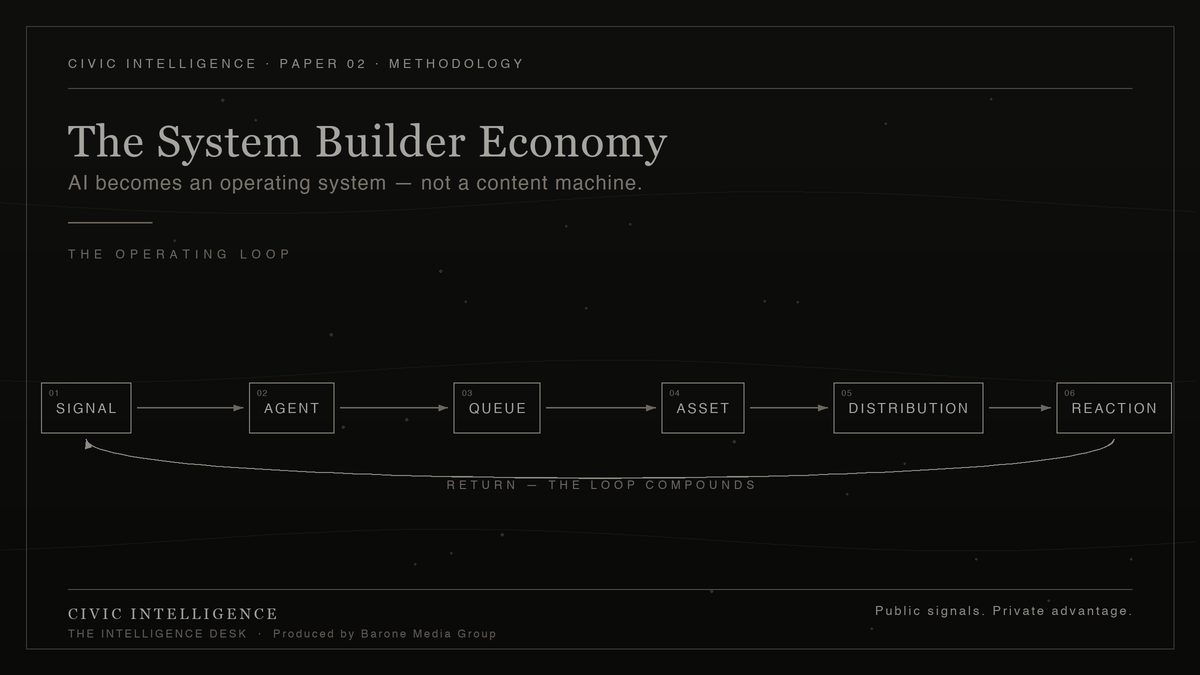
AI as an operating system, not a content machine
Treat a model as a vending machine and you get vending-machine results: one input, one output, no memory, no standards, no follow-through. Treat it as an operating system and the unit of work changes. You stop asking "write me X" and start defining how information enters, how it gets checked, how it becomes a finished artifact, where that artifact goes, and what you learn when it lands.
An operating system has parts that each do one job well and hand off cleanly to the next:
- Research — pulling signal from the noise, on the record, with provenance attached.
- Routing — deciding what matters, to whom, and in what order.
- Production — turning a decision into a finished artifact: a brief, a page, a graphic, a post.
- Quality control — checking the artifact against a standard before anyone sees it.
- Distribution — putting it where it changes what someone does next.
- Feedback — reading the reaction as data, not applause.
- Iteration — feeding that data back in so the next pass starts ahead of the last.
The leverage is not in any single step. It is in the loop closing — output becoming input — without a person re-typing the connective tissue each time.
Agents, subagents, workflows, MCP: the execution infrastructure
This is where the work gets real, and where most people stop. A single model in a chat box cannot run an operating system; it has no hands and no parts. The execution layer supplies both.
Agents and subagents
One agent holds the objective and the standard. It delegates narrow jobs to subagents — search this, draft that, check the other — each with a tight scope and a clear definition of done. The orchestrating agent does not do everything; it decides, delegates, and keeps the standard. That division is what lets a system stay coherent while still doing many things at once.
Workflows
A workflow is the sequence and the gates: what runs, in what order, what must pass before the next step begins, and what stops the line. Gates are not bureaucracy — they are where standards live. A workflow with no gate produces volume; a workflow with the right gates produces output you can stand behind.
MCP and tools
A model that can only talk is trapped. Connect it to tools — files, search, calendars, repositories, publishing surfaces — through a common protocol and it can act, not just describe. That connection is the difference between a system that tells you what to do and one that does the doing and hands you the decision. The skill that matters is wiring those connections so the model reaches exactly what it needs and nothing it shouldn't.
Media is intelligence distribution
Production is not a separate department bolted onto analysis — it is the last mile of the same system. A finding nobody receives changes nothing. The page, the graphic, the post, the brief are not "marketing"; they are how intelligence travels and how it lands as action. A system that can research but cannot ship is half a system. The builders who win treat media as a routing problem: the right artifact, in the right format, to the right reader, at the moment it changes a decision.
Bitcoin as proof, not price
There is a discipline worth borrowing from how Bitcoin works — and it has nothing to do with what it costs. Bitcoin's design lesson is verification: every claim in the system is checked against a shared, tamper-evident record before it is accepted as true. Nobody is asked to trust an assertion; the system is built so the assertion can be proven or rejected on its face.
An intelligence system should hold itself to the same bar. Every output should be verifiable — traceable to a source, checkable against a record, defensible on its own terms. That is the standard a builder bakes in: proof over persuasion, the record over the claim. Used this way, Bitcoin is a metaphor for verification — not a number on a chart, not a position, not a forecast.
Source discipline
A system that produces fast, polished, unverified output is a liability with good formatting. Speed without sourcing manufactures confident error at scale. The fix is structural, not optional: separate what is confirmed from what is a public claim from what is your own labeled interpretation. Attach provenance to every fact as it enters, and never let an unsourced assertion pass a gate. The point of building the system is to make this automatic — so the discipline survives the deadline instead of dying at it.
Human judgment is the input AI cannot supply
None of this removes the person. It relocates them. The model does not decide what is worth doing, what "good" means, which risk is acceptable, or when an answer is wrong in a way no benchmark would catch. It cannot own the consequences. The builder sets the objective, defines the standard, designs the gates, and makes the call the system surfaces. AI scales judgment; it does not originate it. The economy this paper names rewards exactly the judgment AI cannot supply — and punishes the assumption that it can.
Public output, private advantage
A system built this way produces two things at once. It generates public output — work that travels, that establishes a position, that earns attention on the strength of being right. And it accumulates private advantage — the routing, the standards, the loop, the institutional memory that competitors cannot see and cannot copy from the outside. The post is visible. The machine that produced it is not. That gap is the moat.
This is the work: not better prompts, but better systems. The people who can design the workflow, route the information, hold the standard, and turn output into action are the ones AI rewards. Everyone else is still asking it to write faster.
Public intelligence — not legal or investment advice.