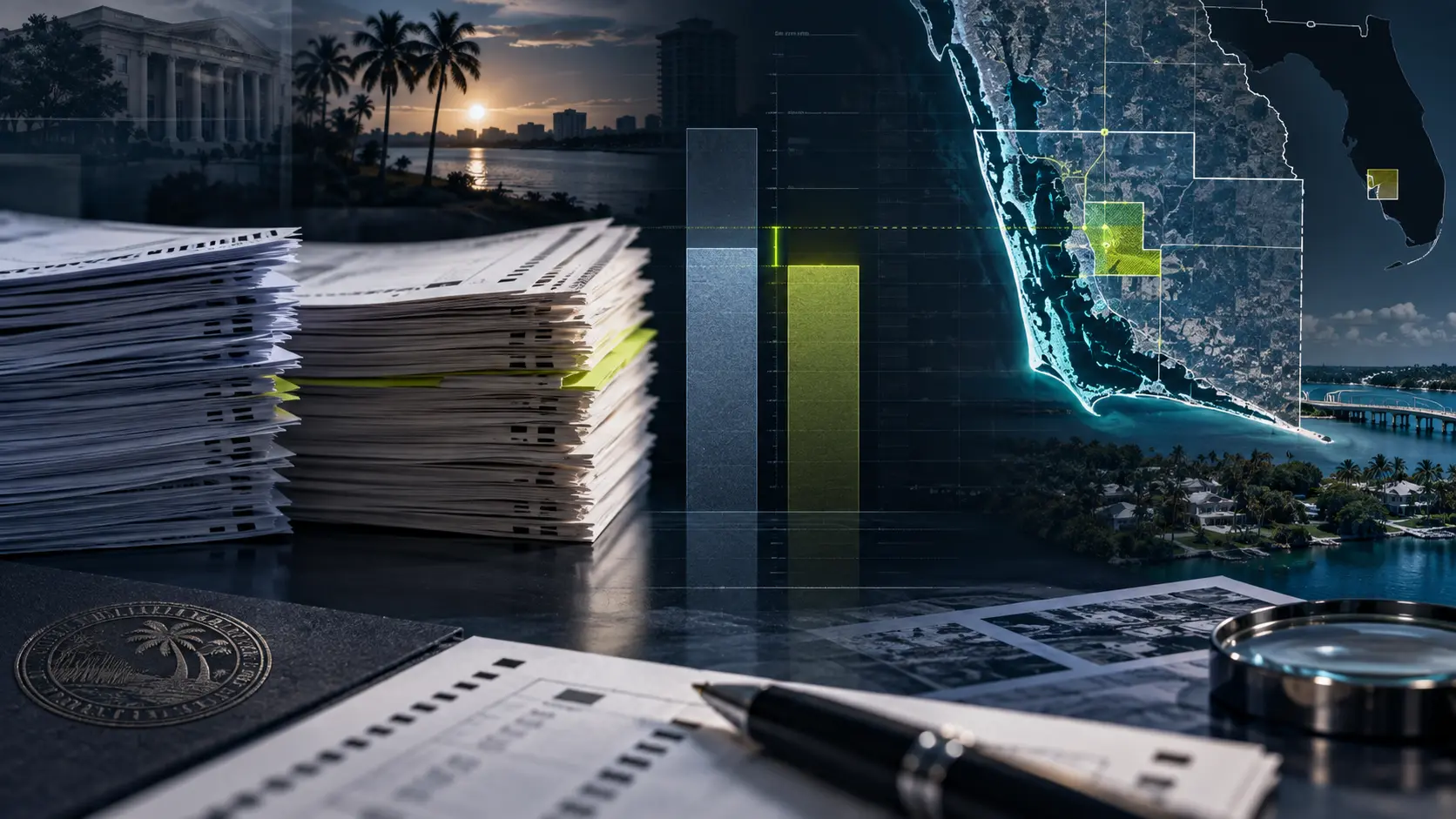
2020: $7,259,691.99 receipts, $6,500,000 candidate loans, $3,738,960.24 operating spending; 20,774 votes, 19.98%, third, 2,718 votes (~2.6 pts) behind the winner.
Naples Decision Files · Episode 01
The 20% Race: Who Actually Has a Path in FL-22?
Money already made Casey Askar competitive in 2020 and finances a fragmented 2026 field, but the public record does not yet show that the Election-Day conversion problem that produced 19.98% has been solved — all three dominant campaigns hold paths that are plausible but fragile.
This page is the canonical editorial and evidence record; the film below is the current published version. Master INTELLIGENCE_DESK_FL22_THE_20_PERCENT_RACE_MASTER_v02_1080P.mp4 · SHA-256 f73007ab18c9573a… · Version 1.0.
Watch
Current film — owner-voice edition.
The finding
Money already made Casey Askar competitive in 2020 and finances a fragmented 2026 field, but the public record does not yet show that the Election-Day conversion problem that produced 19.98% has been solved — all three dominant campaigns hold paths that are plausible but fragile.
An official-records test of Florida's redrawn 22nd Congressional District Republican primary: the 2020 Askar experiment ($7.26M, 19.98%, third), the 2026 seven-candidate field in which three self-financed campaigns hold 97.5% of located receipts, a line-by-line classification of operating spending (97.8% through two vendor clusters; ~$5,000 identifiable field; no polling identified), registration-weighted path scenarios across a district where 62.4% of active Republicans live outside Collier, and the post-July-29 disclosure clock.
What the record shows
Controlling findings, with their evidence states.
Collier 2020 mode pattern: Askar +209 vs Donalds in vote-by-mail, −568 early, −1,373 Election Day. The record shows mail strength and an in-person deficit; it does not establish why.
2026 (through 7/29): Carbonara $6,332,573 receipts / $36,589 cash; Keiser $3,797,856 / $701,594; Askar $2,567,760 / $1,048,396. Top three = 97.52% of located receipts; loans-to-receipts 66.9% / 92.2% / 97.4%.
Askar operating spend: $1,095,212.80 of $1,119,363.96 (97.8424%) through two vendor clusters — TV 73.3%, direct mail 14.8%; identifiable field/canvassing ≈ $5,000; polling: none identified.
Registration-weighted scenarios (182,079 active Republicans; 62.43% outside Collier): repeating 2020's 22.8% Collier share requires ≈22.3% everywhere else for a 22.5% plurality; even 40% of Collier requires ≈12% outside. Not a turnout or vote forecast.
48-hour notices captured through 8/8: Askar $70,250 (3 notices), Keiser $27,500 (2), Carbonara $9,985.84 (1); no new Askar candidate loan on file.
Bounded verdicts: Carbonara, Keiser and Askar each PATH PLAUSIBLE BUT FRAGILE — distinct supporting and contradicting evidence; no win probability asserted.
What the record does not establish
The no-inference rules travel with the film.
- Registration is not turnout and not support.
- Spending is not effectiveness; payment records show where money went, not what it converted.
- Vendor concentration is not ownership, control or coordination.
- Modeled paths are scenarios, not forecasts.
- 48-hour notices show certain late receipts, not the full post-July-29 spending picture.
- Independent-expenditure itemization was PENDING SOURCE at capture.
Chapters
Chapter map
- 0:00 The 2020 experiment
- 0:50 Collier 2020: the conversion pattern
- 1:21 A new district, a seven-candidate field
- 2:04 What the money purchased
- 2:40 Registration and the path scenarios
- 3:07 The disclosure clock
- 3:25 Three bounded verdicts
- 4:02 Sources, cutoff and the answer
Transcript
Complete final narration.
Casey Askar does not need proof that money can make him competitive. His prior campaign already proved that. A heavily financed operation reached approximately twenty percent of the vote — and still fell short. The question in 2026 is not whether money can create a campaign. It is whether this campaign fixed the part that failed.
Twenty twenty. Seven point two six million dollars in receipts — six and a half million of it his own loans. Three point seven four million spent operating. Result: twenty thousand seven hundred seventy-four votes — just under twenty percent. Third, by two thousand seven hundred eighteen votes.
Money already made Askar competitive. It did not close the conversion gap.
Collier tells it sharper. Askar: twenty-two point eight percent. Byron Donalds: twenty-eight point eight. By mode: mail, Askar ahead by two hundred nine. Early voting, behind by five hundred sixty-eight. Election Day, behind by thirteen hundred seventy-three. The record shows mail strength and an in-person deficit. It does not establish why that pattern occurred. So the 2026 question is narrow: has this campaign changed the conversion structure that failed in 2020?
Florida's May map rebuilt District 22 — parts of Collier, Hendry, Broward and Palm Beach counties. No incumbent. Seven Republicans. Primary: August eighteenth.
Three campaigns hold ninety-seven and a half percent of the field's money. All three run on candidate capital. Carbonara leads receipts: six point three million, two-thirds his own loans — spent down to thirty-six thousand dollars. Keiser: three point eight million, ninety-two percent self-loaned — about seven hundred thousand left. Askar: two point five seven million, ninety-seven percent his own loans. Not the receipts leader. His strongest recorded advantage: late cash — just over one million dollars, and the flexibility it buys.
What did the money purchase? Ninety-seven point eight percent of Askar's operating spending ran through two vendor clusters: an Ohio broadcast buyer, a Miami mail-and-text firm. Line by line: television, seventy-three percent. Mail, fifteen. Radio, text, creative, consulting: most of the rest. Identifiable field and canvassing: five thousand dollars. Polling: none identified. Payments show where money went — not what it converted. On the record's face: a compressed 2020 structure — not a different conversion system.
Now the map. One hundred eighty-two thousand active Republicans. Sixty-eight thousand in Collier — sixty-two percent outside. Weight the registration: a scenario, not a forecast. Repeat his 2020 Collier share, and he needs about twenty-two percent everywhere else to clear a twenty-two-and-a-half-percent plurality. Even at forty percent of Collier, he needs one Republican in eight beyond it. Collier creates leverage only if he wins it decisively.
One caution. The pre-primary report stops at July twenty-ninth. Forty-eight-hour notices show seventy thousand dollars of late receipts for Askar — most of the three. The public can see certain late receipts. It cannot yet see the full late-spending picture.
Three bounded verdicts. Carbonara: path plausible but fragile. The largest operation, fully deployed — almost nothing left to adjust. Keiser: path plausible but fragile. An eastern base and cash in reserve — no districtwide proof of conversion. Askar: path plausible but fragile. For him: a proven twenty-percent baseline, a fragmented field, and the most late cash in the race. Against him: he did not win Collier in 2020, he trailed in person, most Republicans live outside Collier — and the record does not yet establish a districtwide field operation.
The money is real. The late cash is real. The path is real. But the record does not yet show that the conversion problem has been solved. Collier must become a decisive advantage — or the campaign must operate nearly districtwide. That is the difference between another twenty-percent campaign and a winning plurality.
This is Intelligence Desk.
Methodology
What was tested, and what the method cannot establish.
Frozen owner figures verified to the cent against FEC committee totals (cycle 2026, coverage through 2026-07-29); itemized Schedule B parsed from raw docquery .fec filings and classified into 16 spending categories; 48-hour notices summed from F6 filings; 2020 results and mode splits from official county records; path scenarios computed as registration-weighted shares o=(T×182,079−c×68,403)/113,676 across plurality targets 20–27.5% and Collier shares 22.8–40%. The method cannot establish turnout, persuasion, effectiveness, coordination or outcomes.
Source ledger
Every controlling record, named.
| Issuing body | Record | Record date | Captured | ID | Status | Supports |
|---|---|---|---|---|---|---|
| Federal Election Commission | Committee financial totals, 2026 cycle (C00952663, C00901793, C00950964, C00935452, C00951293, C00950113, C00868893) | 2026-07-29 | 2026-08-08 | EP1-SRC-001 | VERIFIED | 2026 field table; cash, debt, loans, spending |
| Federal Election Commission | Itemized filings FEC-1996734 and FEC-2004686 (Casey for Congress Schedule B) | 2026-07-29 | 2026-08-08 | EP1-SRC-002 | VERIFIED | Two-cluster vendor concentration and category classification |
| Federal Election Commission | 48-hour notices FEC-2003302 / 2004684 / 2005002 (Askar), two notices (Keiser), one notice (Carbonara) | 2026-08-07 | 2026-08-08 | EP1-SRC-003 | VERIFIED | Late-receipts comparison |
| FEC + Collier County Supervisor of Elections | 2020-cycle committee filings and official 2020 primary results with mode splits | 2020-08-18 | 2026-08-08 | EP1-SRC-004 | VERIFIED | 2020 experiment and Collier conversion pattern |
| Florida Division of Elections | Official book-closing registration report, 2026 primary | 2026-07-20 | 2026-08-08 | EP1-SRC-005 | VERIFIED | 182,079 / 68,403 / 113,676 registration baseline |
| U.S. Census Bureau | Cartographic county boundary files, 2024 | 2024-12-31 | 2026-08-08 | EP1-SRC-006 | VERIFIED | County-anchor map |
| WUSF / WGCU / Naples Press | County-level composition of redrawn FL-22 (May 2026 map) | 2026-05-06 | 2026-08-08 | EP1-SRC-007 | REPORTED — NOT INDEPENDENTLY VERIFIED | District span; precise boundary shapefile PENDING SOURCE |
Corrections and updates
Version 1.0 · last updated 2026-08-11
- Release-day official-record check · 2026-08-12 — PROCEED — no controlling conclusion changed. Release-day official-record check 2026-08-12: field of seven Republicans remains qualified for the Aug 18, 2026 primary; no withdrawals, disqualifications, or district/date changes identified. Michael Carbonara remains the leading self-funder (later public reporting cites roughly $5.9M raised with about $3.77M self-loaned; the figures shown in the film reflect its stated evidence cutoff and are not restated here). Independent-expenditure itemization remains as disclosed at capture. No later filing changes a controlling conclusion; the film's evidence cutoff (FEC reports through 07-29-2026; 48-hour notices through 08-08-2026) remains the authoritative in-film boundary.
- v02 · 2026-08-08 — Internal-review graphics removed; sources card repositioned before conclusion; brand close added. No controlling figure changed. Video replaced (v01 to v02). (video changed)
For private briefings, portfolio monitoring and source-linked decision intelligence: