A development pipeline is not a construction pipeline
An announcement, an entitlement, a permit, financing, commencement and delivery describe different facts. Name the stage, show the record and identify what must happen next.
Perspectives sets the method. The Naples Decision Files apply it. Read the applied work
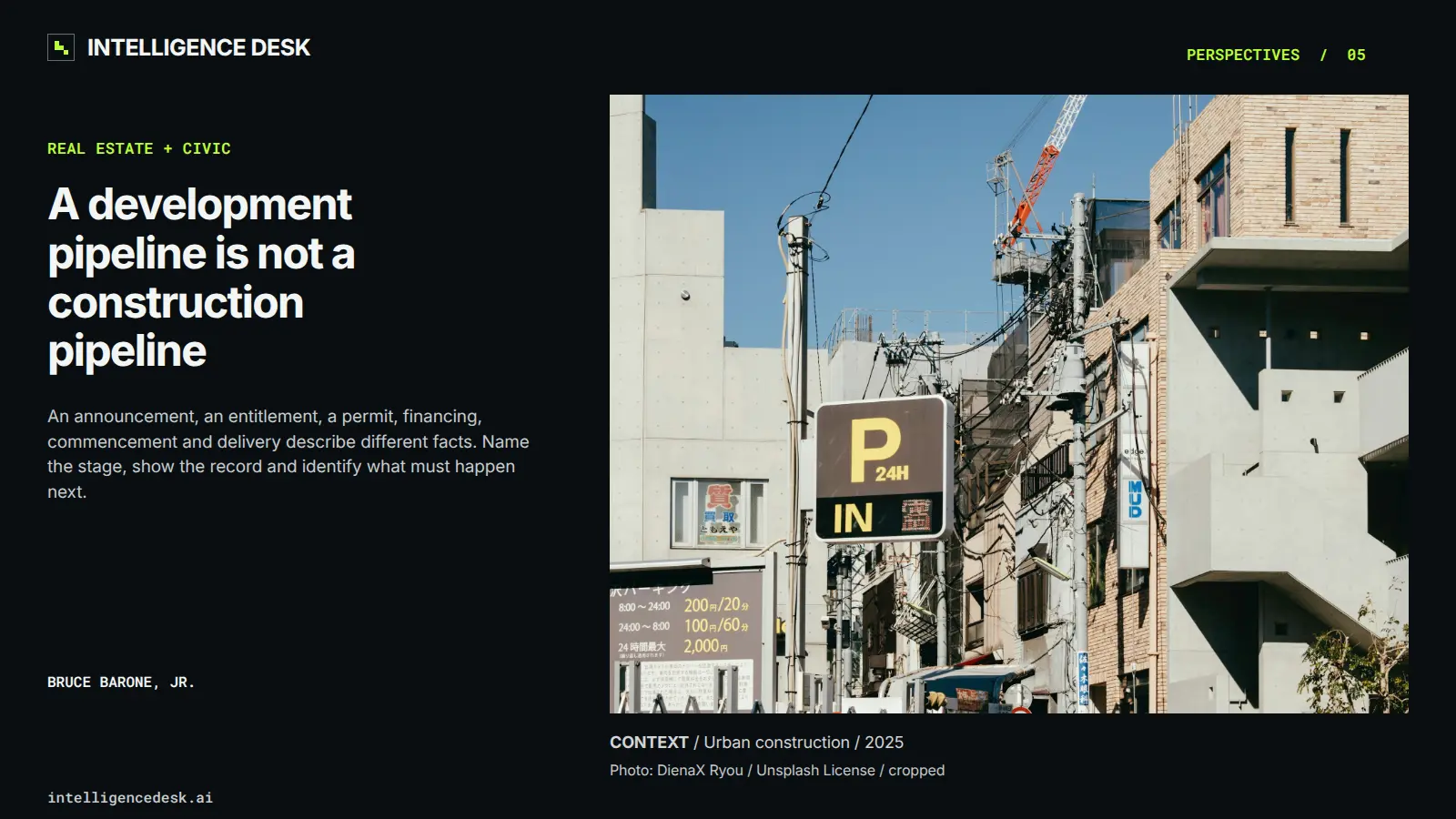
A city can point to a long development pipeline and still have relatively little under construction.
The problem is not necessarily exaggeration. It is often classification. A proposed hotel announced in a press release, a mixed-use project approved with conditions, a building with an issued permit and a job with crews working on site may all appear on the same list. The total looks precise. The projects are not in the same condition.
That distinction matters to more than developers. A business improvement district may use the pipeline to anticipate foot traffic and merchant disruption. A city may use it to discuss tax base, utility demand or public safety. An architect may use it to identify work moving toward design and permitting. A broker or investor may use it to describe future supply. A resident may hear the same number as a promise about what the city will soon become.
Each audience deserves to know what the number actually counts. The right question is not simply, ‘How many projects are in the pipeline?’ It is: What stage has each project reached, what record establishes that stage and what must happen before it advances?
Announcement is not status
An announcement establishes that someone has described an intention. It may identify a site, a development team, a proposed use, an estimated investment and a target date. It can be relevant evidence of market interest. It does not establish that the proponent controls the property, has filed an application, holds development rights, has obtained a building permit, has closed financing or has begun work.
The announcement stage should therefore be narrow. Record the speaker, date, site, stated concept and source. Then identify the first public or independently verifiable threshold that would move the project forward.
If the site is not identified, say so. If ownership or site control has not been established, preserve that gap. If the investment figure comes from the proponent, label it as a reported estimate rather than combining it with signed contracts, recorded debt or completed expenditures. An announcement may be important. It is not construction.
Entitlement establishes permission, with conditions
Entitlement is the public-law stage: rezoning, a conditional or special use, a variance, subdivision approval, design review, a site plan or another land-use decision required for the proposed project.
The exact instruments vary by jurisdiction, but the principle is stable. An entitlement establishes permission to pursue a defined use or plan under stated conditions. It does not itself authorize every construction activity. San Luis Obispo County states the distinction directly: approval of a land-use permit entitles the use, while separate permits may still be required for construction or grading. That is a useful national rule of interpretation even where the local terminology differs. [2]
A proper entitlement record should identify the deciding body or official; the application and final instrument; the approved use, density, height, phasing or other controlling scope; conditions that must be satisfied; expiration, extension and appeal provisions; and later amendments that changed the approved plan.
‘Approved’ is too broad when those details are missing. A recommendation is not a final approval. A conceptual presentation is not an application. A preliminary plan is not necessarily the operative plan. An approval subject to unresolved conditions is not the same as a fully cleared project.
The record should state exactly what the decision permitted and what it did not.
A permit authorizes work; it does not prove work occurred
Building permits move the inquiry from land use to construction documents, code compliance and authorized scope. They matter because they are attached to a defined set of work. They still require careful reading.
The U.S. Census Bureau calls building permits ‘units authorized,’ then reports housing starts and completions separately. That federal statistical structure captures the core point: authorization, commencement and completion are different measures. [1]
A permit record should include the permit number, issue date, status, described scope, valuation as reported in the permit record, contractor where available and any linked trade permits. It should also show whether the permit is active, expired, revoked, superseded or limited to demolition, site work, foundations or another partial scope.
Do not treat an application as an issued permit. Do not treat demolition as vertical construction. Do not treat one permit for an early phase as authorization for the entire project. Do not add permit valuations across overlapping permits without first establishing whether they describe separate work. An issued permit is evidence that specified work may proceed. The next question is whether it did.
Financing requires its own evidence
A project can be entitled and permitted without having the capital required to build. Financing therefore belongs in the pipeline, but it is often the least visible stage.
Public evidence may include a recorded mortgage, a lender identified in a Florida notice of commencement, a public bond or incentive record, a regulated-company filing, or a direct statement from an authorized party that financing has closed. Each proves only what the document says.
A mortgage can establish a secured obligation without proving that the entire construction budget is funded or available. An announced capital partner does not necessarily establish a closed transaction. A public incentive approval does not prove that private equity and construction debt are complete. The absence of a public financing record does not prove that financing is absent.
The honest status may be ‘not independently verified.’ That is more useful than converting silence into certainty. For public-facing pipeline work, record the source and confidence level. Distinguish verified closing evidence from a reported financing plan. If the amount is not public, do not invent one from estimated project cost.
Commencement needs physical and documentary proof
‘Groundbreaking’ is often used as a synonym for construction start. It should not be.
A ceremonial event proves that a ceremony occurred. A fence, a construction trailer or equipment on site may indicate preparation. Clearing, demolition, utility relocation, excavation, foundation work and vertical construction are materially different stages.
Florida’s notice-of-commencement statute is especially instructive. Section 713.13 requires the notice before actually commencing an improvement and before the first inspection, but it also states that the notice becomes void if the improvement is not actually commenced within 90 days after recording. The document is therefore important evidence of preparation and project identity; by itself, it is not proof that construction began. [3]
Commencement should be tied to a stated rule. For a major building, the strongest public record may combine an active permit with a dated inspection showing foundation work, a jurisdictional start record, or documented physical work matching the permitted scope. For phased projects, identify the phase. Site preparation for one component should not automatically move the full master plan into ‘under construction.’
The record should also retain the date of the last verified activity. A project can start and later stall.
Delivery is not a forecast date
Delivery occurs when the relevant improvement is complete enough for its intended use, not when a schedule says it should be.
The evidence depends on the project. For a building, it may include a certificate of occupancy, temporary certificate of occupancy, letter of completion or other jurisdictional closeout. New York City’s Department of Buildings describes a certificate of occupancy as confirming legal use and permitted occupancy after completed work, approvals and required sign-offs. Other jurisdictions use different instruments, but the principle remains: delivery requires a completion record tied to the use being claimed. [4]
Opening announcements can supplement that record, not replace it. A hotel may open in phases. Residential units may receive certificates while retail remains unfinished. Public improvements may be substantially complete while punch-list work, reimbursement or final acceptance remains open.
‘Completed’ should therefore name the completed scope and evidence date. ‘Open’ should identify what opened. ‘Delivered’ should not silently absorb unfinished phases.
Use one pipeline, with six distinct thresholds
A useful public development register can remain concise. Each project needs a stable identity and six stage fields. Announced establishes a stated intention, not site control, approval, financing or construction. Entitled establishes permission for a defined use or plan, not building authorization or financial readiness. Permitted establishes authorization for stated work, not commencement or completion.
Financed records a verified capital event only at the level the evidence discloses. Commenced requires an active permit plus a dated inspection, jurisdictional start record or documented physical work matching the permitted scope. Delivered requires occupancy, completion, acceptance or an equivalent closeout record tied to the defined scope.
Every field should carry a source date. When a project changes, preserve the prior status and record the event that justified the change. Do not overwrite the earlier promise with the new one.
That history makes the pipeline useful. It shows time spent in review, the gap between approval and construction, projects that expired, work that stalled and teams that delivered. It also prevents the same proposed investment from being repeatedly announced as new progress.
The pipeline should expose the next decision
The purpose of classification is not to make the list look smaller. It is to make the next action visible.
An announced project may need a filed application. An entitled project may need conditions cleared. A permitted project may need financing or a notice to proceed. A started project may need an inspection milestone. A substantially completed project may need final acceptance.
For cities and districts, that produces a more credible account of future capacity, infrastructure demand and near-term disruption. For architects, engineers and contractors, it separates speculative interest from projects approaching professional work. For owners, investors and brokers, it exposes dependencies that can change timing and value. For the public, it replaces promotional accumulation with a record that can be tested.
A development pipeline is a statement about possibility. A construction pipeline is a statement about authorized and evidenced work. Both are useful. They become misleading when they are treated as the same thing.
The standard is simple: name the stage, show the record, preserve the uncertainty and identify what must happen next.
This essay describes a research and reporting method. It does not determine development rights, financing availability, permit compliance or construction status for any specific property. Those questions require the controlling local record and, where applicable, qualified legal, planning, design, engineering, title and financial professionals.
Sources and record notes
- Building Permits Survey — U.S. Census Bureau.
The federal series reports housing units authorized by building permits and reports starts and completions as separate measures.
- Land Use Permits — County of San Luis Obispo Planning and Building.
The County explains that land-use approval entitles the use while separate construction or grading permits may still be required.
- Florida Statutes 713.13 — Florida Legislature.
The statute requires a notice of commencement before actually commencing an improvement and before the first inspection, and provides that the notice becomes void if the improvement is not actually commenced within 90 days after recording.
- Certificate of Occupancy — New York City Department of Buildings.
The Department explains that a certificate of occupancy confirms legal use and permitted occupancy after completed work, approvals and required sign-offs.
Continue the conversation
What decision are you working through?
Bring a civic question, a property decision or a public record that deserves closer examination.
Read freely. Contact details are requested only when you choose to send an inquiry.