Bitcoin urbanism starts on Main Street
Judge civic Bitcoin by additional commerce, useful investment and the public benefit it can demonstrate.
Perspectives sets the method. The Naples Decision Files apply it. Read the applied work
Disclosure and scope. Disclosure: Bruce Barone, Jr. owns Bitcoin and co-founded Civic Bitcoin. The local pilot described here is a proposal; no implemented pilot or municipal partnership is claimed.
A town has no shortage of technologies competing for its attention. The useful question is what each one could do for the people and businesses already there. Bitcoin deserves a serious civic discussion when the proposal connects it to commerce, skills, productive investment or a public improvement that can be measured.
For this essay, Main Street means the ordinary local economy: merchants, workers, property, public space and the institutions that serve them.
I use Bitcoin urbanism to describe that work: evaluating how Bitcoin-related activity could strengthen actual places. I call its practical application Civic Bitcoin, a term I use for this work and the name of a venture I co-founded. A merchant program, a training initiative, a donation-funded improvement and a mining installation are different proposals. They need different operating plans and different tests of success.
The first task is to define the local purpose. A downtown organization trying to bring new customers to its merchants should be able to explain the program without making a prediction about Bitcoin’s price. A city considering payment technology should be able to describe settlement and cost before calling the initiative an economic-development strategy.
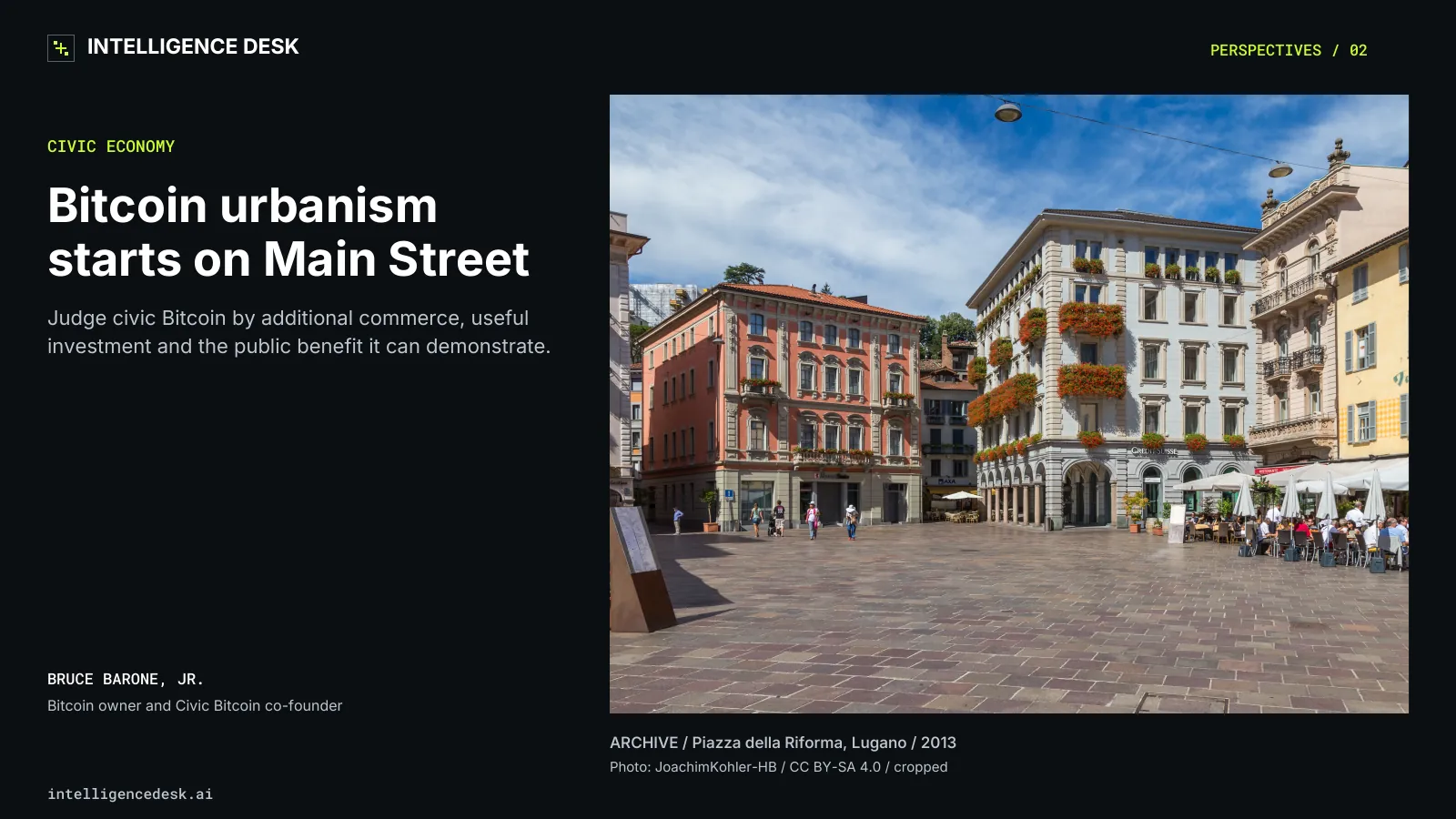
What Lugano actually demonstrates
The City of Lugano allows municipal invoices, including taxes and fines, to be paid using Bitcoin, Bitcoin over Lightning and the USDT stablecoin issued by Tether. Its payment guidance also states that receipts are immediately converted into Swiss francs by its collection partner. The City says it does not operate a cryptocurrency treasury. [1]
That detail makes the example more useful. A payment option and a public reserve investment can be designed separately. Lugano’s wider Plan B program includes education, events and a physical hub for startups and professionals. Those activities demonstrate implementation choices; the program’s existence does not establish what a similar effort would earn for a Florida town. [2]
Start with a bounded merchant test
A first local application could be a privately funded, voluntary merchant pilot tied to an existing district. Give participants a clear account of fees, settlement choices, refunds and the support available when something fails. Set a fixed duration and a spending ceiling. Let businesses decide whether participation fits their customers and operations.
Measure completed transactions, merchant receipts after fees, repeat use and the time spent administering the program. Record ordinary trading conditions before launch. Compare results with similar periods and, where feasible, similar businesses that did not participate. An event, a holiday or favorable weather can affect sales too. A credible report explains those limitations.
A payment terminal in a window is an implementation count. Additional business is an outcome. The pilot needs both, because low use and high operating effort would be valuable findings even if the launch attracted attention.
Give capital a specific civic destination
Bitcoin-oriented entrepreneurs, visitors and donors could contribute to a local strategy through ordinary business recruitment, workspace, education or philanthropy. The offer should be concrete. A nonprofit might evaluate accepting donations for a defined public-space improvement, with a conversion policy, a budget and reporting on completed work.
The same planning disciplines still apply to new enterprises: lawful use, a suitable building, access, utilities and compatibility with neighbors. The origin of capital does not resolve those questions. It makes a clear local proposition more important.
Separate mining from the merchant program
Mining has equipment, electricity, cooling, maintenance and site requirements. Fort Worth’s November 2022 written review reported $1,019.31 after electricity from its six-month pilot. The hardware was donated, so the City incurred no purchase cost. Its council presentation explains that three miners were replaced by one newer unit during the second month: the total spans two configurations. The written review reported nearly 753 million media impressions; the council presentation used the slightly less precise formulation more than 752 million global media impressions. The records therefore agree at the rounded level while showing why the source wording matters. [3] Media impressions are not unique people, realized investment or recurring operating revenue.
Any proposed installation needs its own cost and engineering record, including the cost of obtaining equipment when a donor is not paying. A claim about useful heat, grid services or employment needs support from the actual design and contracts. Compare the proposal with other uses of the site and electricity. Launch attention does not establish lasting economic benefit.
Design the evaluation before the launch
The pilot’s operating sheet should state who pays, which businesses participate, how transactions are settled and what information will be collected. Use aggregate reporting that protects customer and merchant confidentiality. Record support incidents and staff effort alongside sales. Identify any provider sponsorship so readers can judge the commercial interests behind the experiment.
Agree on a continuation test in advance. Businesses might require repeat use, manageable administration and acceptable net receipts. The district might require an affordable cost per active participant and evidence of interest beyond the launch event. Those thresholds should come from the participants’ economics, not an invented universal benchmark. Publish an unsuccessful test with the same clarity as a successful one. Useful learning can justify a small experiment; expansion requires its own case.
Define the public exposure before the pilot
Public reserves require a distinct decision. Florida’s local-government investment statute prioritizes safety of principal and liquidity for covered policies. Authority for a particular investment requires examination of current law, the entity’s powers and its adopted policy. A successful merchant program would not answer that legal and financial question. [4]
For a first downtown test, I would use a privately funded commerce or education program with a defined end date. Publish the cost, participation, observed results and reasons to continue, revise or stop. Bitcoin urbanism earns a place in civic strategy when a town can explain the useful activity it produced. The argument becomes stronger when the measurement is demanding.
Sources and record notes
- Municipal cryptocurrency payments — City of Lugano.
Payment guidance and FAQ, especially the treasury question: crypto payments are converted into Swiss francs; the City says it does not operate a cryptocurrency treasury.
- Lugano Plan B — City of Lugano.
Program description: education, a startup hub, events and payments. Program descriptions are not independent economic-impact evaluations.
- City Bitcoin program expected to draw innovation and commerce — City of Fort Worth.
City written review, November 2, 2022: $1,019.31 after electricity and nearly 753 million media impressions. Council presentation, November 1, 1:16–1:19: more than 752 million global media impressions, donated equipment and replacement of three miners with one during month two. No full lifecycle profit claim.
- Florida Statutes 218.415 — Florida Legislature.
Opening provisions and subsection (2): safety of principal and liquidity take priority over investment returns for covered local-government policies.
Continue the conversation
What decision are you working through?
Bring a civic question, a property decision or a public record that deserves closer examination.
Read freely. Contact details are requested only when you choose to send an inquiry.