Give AI a Job Worth Doing
Local understanding, applied AI and a disciplined path from information to action.
Perspectives sets the method. The Naples Decision Files apply it. Read the applied work

An owner is looking at a property. There is a listing, a zoning map, a promising rendering and a folder of public records. AI can help organize that material into a presentation. The owner still has a harder question: what should I do next?
That is the question shaping my AI work.
Four rules I work by
- Start with a real decision and identify who is responsible for it.
- Keep proposals, approvals and completed work separate. Preserve source dates and unresolved questions.
- Define the AI assignment: input, output, reviewer, deadline and stopping condition.
- Test against actual work before claiming improvements in time, cost or accuracy.
I am building across several worlds: an AI studio, business workflows, and Intelligence Desk’s real estate and civic research. Working across those areas keeps bringing me back to the same challenge. A system has to carry useful work from an initial idea through the details that make the result dependable.
For a film, that might mean maintaining a character across scenes. For a property decision, it means maintaining the distinction between a proposal, an approval and work actually completed. In both cases, the impressive first output is only the beginning.
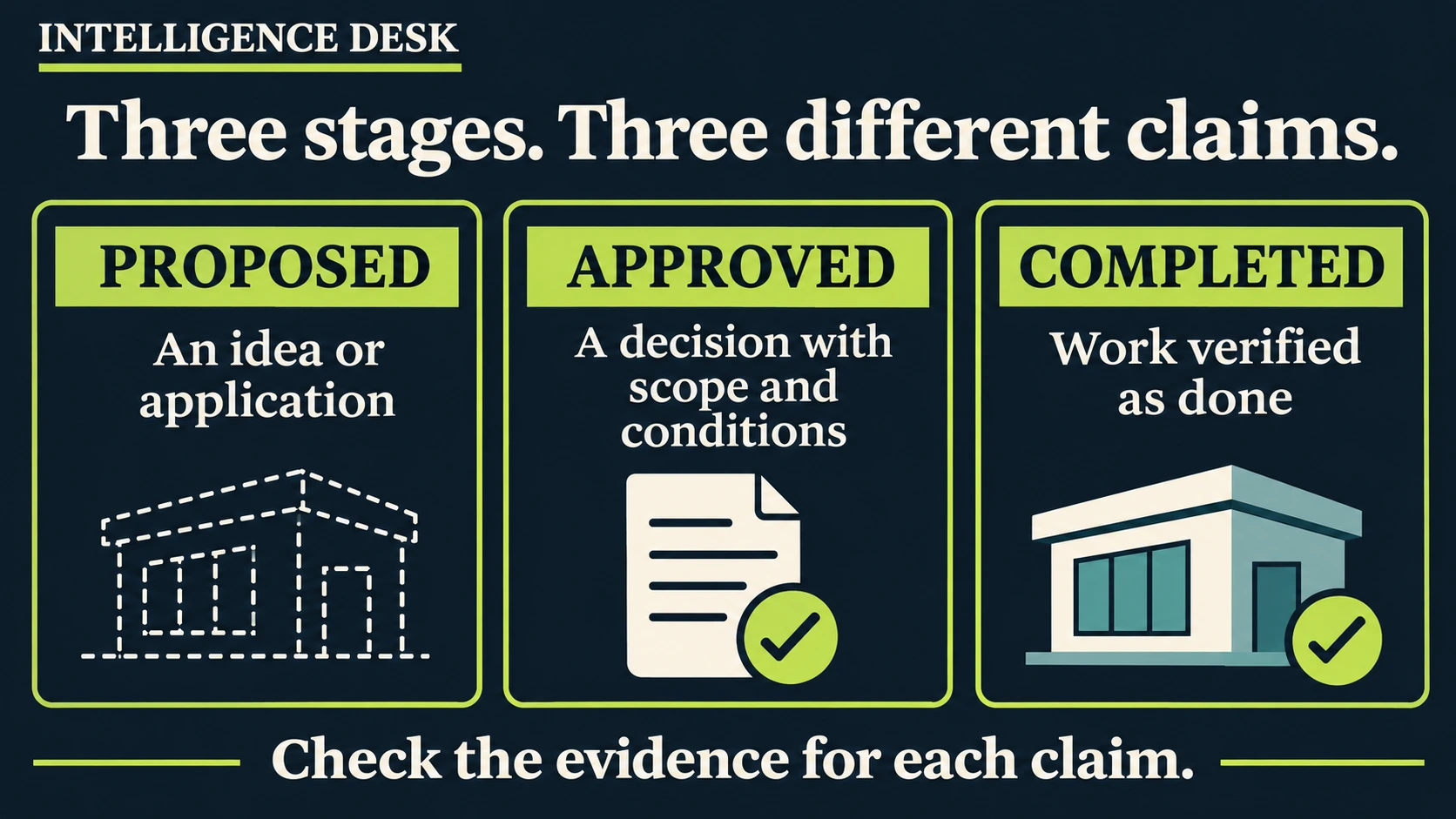
- Proposed: an idea or application.
- Approved: a decision with a defined scope and conditions.
- Completed: work verified as done. A proposal or approval alone does not establish completion.
Start with a decision someone owns
Consider a property assignment: an owner wants to know whether a site merits a deeper redevelopment review.
The first useful AI task is modest. Organize the available documents. Identify the parcel and the dates. Extract the stated uses, conditions and unresolved questions. Build a list of records that could change the decision.
Then somebody has to check the work.
Before drawing conclusions from a concept rendering, I would check current approvals, conditions and permit scope with the relevant local authority. I would date the staff report, look for later decisions and read exactly what the permit authorizes. A missing document should remain an open question.
The deliverable I want is a concise account of what is established, what remains open, and which next action is worth paying for. That could lead to a conversation with a planner, a title review, a design study or a decision to stop investigating.
I use local knowledge to decide which questions deserve attention. I want the team researching the question that could actually change its next move.
A missing document should remain an open question.
What building Intelligence Desk is teaching me
The work behind Intelligence Desk is making that lesson concrete.
A dated example from the airport record
One real example is Intelligence Desk’s Naples airport brief, which labels its evidence check September 17, 2026. It described proposed settlement principles and left the parties’ acceptance unresolved.
The minutes correct the brief. Printed page 2 of the signed minutes of the September 17 joint meeting records that the Authority Board unanimously concluded it could not support the proposal as presented. My brief had left the parties’ acceptance unresolved. That was accurate on September 17 and incomplete afterwards, and the correction belongs here in the essay rather than in a footnote.
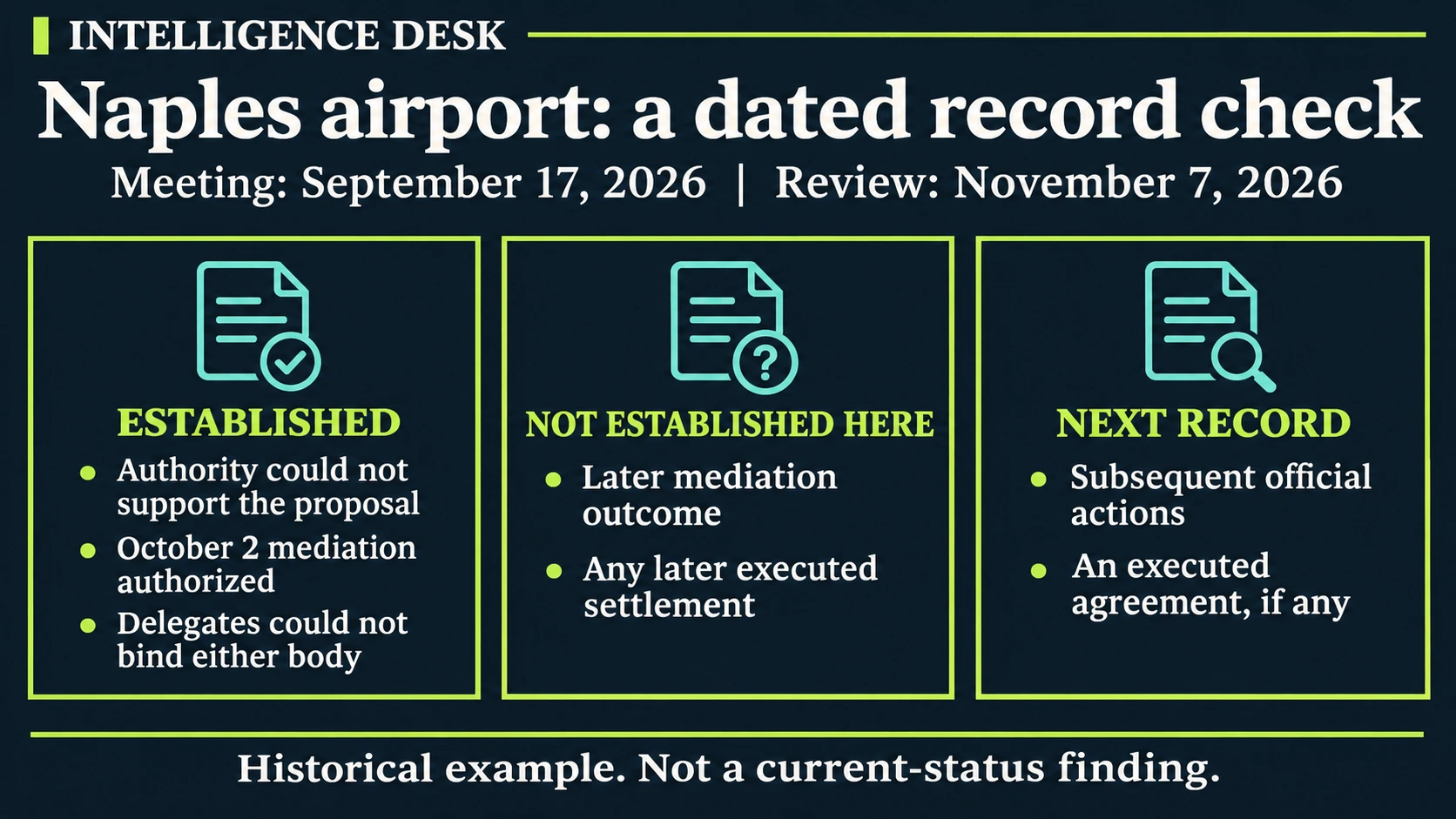
- Established: the Airport Authority did not support the terms as proposed. Both bodies authorized October 2 mediation, and their representatives could not bind either body.
- Not established by these records: the later mediation outcome or any later executed settlement.
- Next action: obtain subsequent official actions and any executed agreement before making a current-status claim.
The AI assignment here is concrete: compare the proposal, the brief and the minutes, preserve their dates, and flag the conclusion that needs updating. A person checks the passages and approves the change. There is one more thing in those minutes worth sitting with. Printed page 3 discloses that the minutes were prepared by Microsoft Copilot using a verbatim transcript, and then signed. The record I am correcting my own AI-assisted brief against was itself drafted by AI and made authoritative by a human signature. That is not an argument against either document. It is the reason the signature matters.
A selected-record watch needs individual source dates. An election reporting page needs to distinguish unofficial returns from certification. A development update needs to attribute an operator’s forecast and preserve the gap between that forecast and verified completion.
Those distinctions look small until somebody relies on the answer.
I am using AI in the work of assembling research, developing the site and testing how information reaches the reader. The standard I am building toward is visible in the product: a reader should be able to move from a finding to its source and understand the limits of the finding.
The development process has also been instructive. A preview can look ready while its generated files still differ from the reviewed source. A test can pass while the final release remains incomplete. The useful discipline is to track what actually happened and what still needs to happen.
That is a practical lesson for any business considering AI: define completion before delegating the job.
Give the workflow a boundary
For an assignment like this, I want five things defined: the input, output, reviewer, deadline and stopping condition.
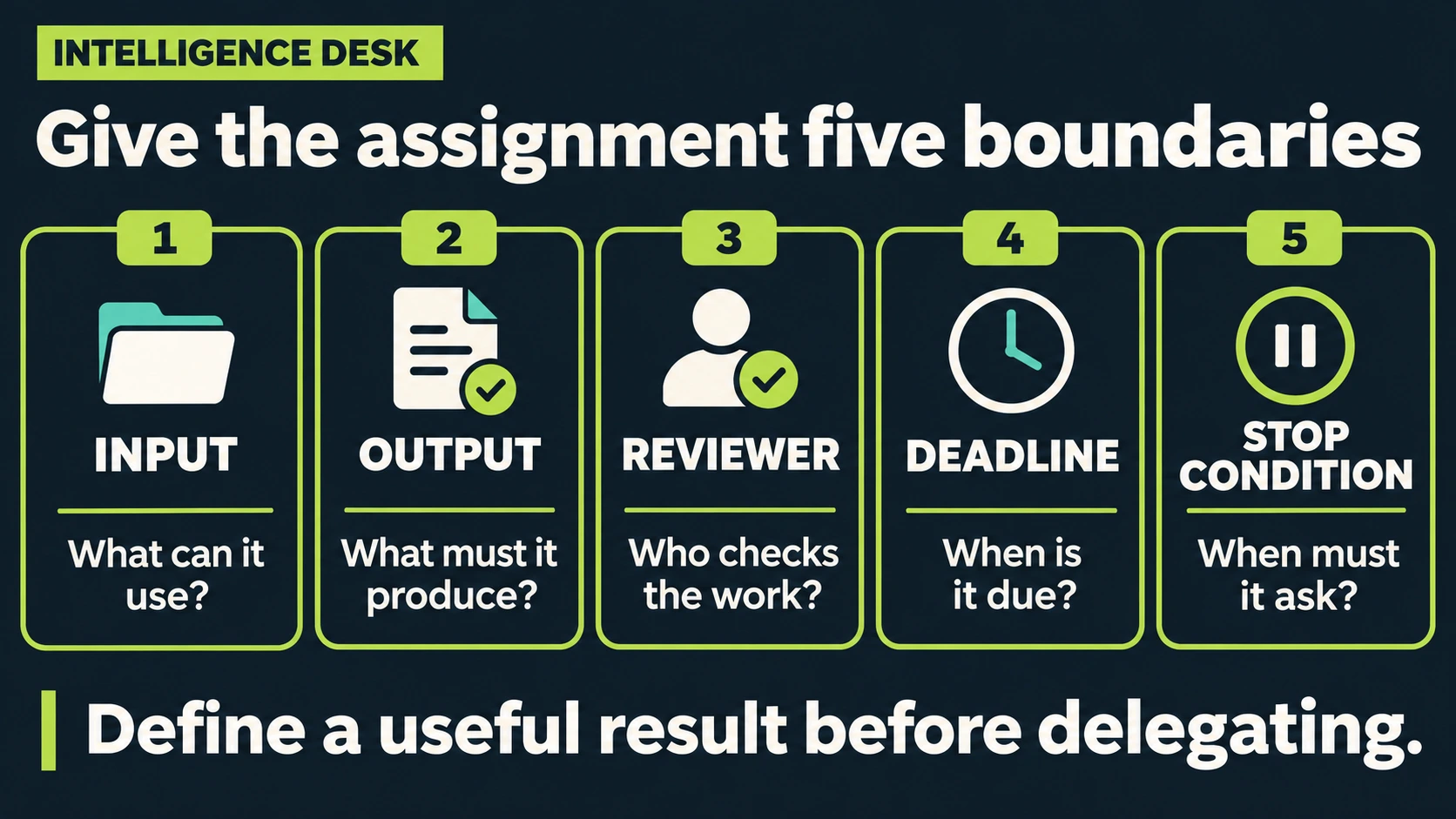
- Input: what can the system use?
- Output: what must it produce?
- Reviewer: who checks the work?
- Deadline: when is it due?
- Stopping condition: when must it ask for a decision?
For that assignment, I would specify: use this approved folder of project documents, prepare a dated issue register with a source for each material claim, and return it to the project lead by 3 p.m. Friday. Stop and ask if records conflict or a required document is missing. The project lead reviews the result and decides whether it is acceptable.
That is a job an organization can evaluate.
In its December 19, 2024 essay, Anthropic separates workflows that follow programmed paths from agents that decide how to proceed and use tools. It recommends starting simply and adding complexity when the task warrants it. I take that as a principle for defining an assignment, rather than a prediction about which product will win. Building effective agents
The business owner should be able to explain the assignment without knowing the model’s name. I want that assignment clear before adding autonomy.
Keep judgment close to the evidence
Generative AI can present inaccurate answers with confidence, including faulty explanations or citations. NIST’s July 26, 2024 Generative AI Profile discusses this risk and offers voluntary guidance for managing risks throughout a system’s lifecycle. NIST Generative AI Profile
My working response is to keep the evidence beside the conclusion.
A research system should identify where a statement came from and when the source was checked. A creative system should preserve the approved reference. A business workflow should retain the decision owner and the step that needs permission.
These are design choices that make a result easier to question and correct.
I would rather examine a small workflow that exposes its failures than judge a broad demonstration only by its best output.
My working response is to keep the evidence beside the conclusion.
The connection to real estate Bitcoin and urbanism
My interests meet at the point where a system changes what people can do in a place.
Real estate turns decisions into physical consequences. Urbanism asks how those consequences accumulate across streets, districts and cities. Bitcoin raises questions about payments, ownership, infrastructure and institutional choices. I am interested in how AI could change the way information and work move through these subjects.
Each subject deserves its own evidence. They become interesting together when they meet a concrete problem.
What would make a district’s project information useful to its merchants? Which part of a property review could be made more repeatable? What would a payment experiment need to demonstrate before a business adopted it? How could a design team preserve its judgment while reducing administrative work?
Those are the kinds of questions I want Intelligence Desk to explore. They create room for an argument, an example and a practical test.
Turn the method into a consulting assignment
The first assignment should be small enough to finish and meaningful enough to matter.
I would start with one recurring decision or workflow. Map how it works today. Identify the information it needs, the person responsible and the places where work gets delayed or loses context. Build a bounded pilot and review it against examples from the actual work.
The resulting package should be tangible: a workflow map, a working prototype where appropriate, a record of the test, and a recommendation about what to keep, change or stop.
Time, cost, error rates and review effort can then be measured. Claims about improvement should follow those measurements.
For an owner, district or project team, that creates a clear way to begin a consulting conversation. Bring a real problem and enough material to examine it. We can define the assignment before expanding the system.
Show the work as it develops
I want to document the work as it develops: what I asked the system to do, what the evidence supported and what changed after review. That is how I want to build the consulting work at Intelligence Desk: one defined assignment at a time, with results people can examine.
Have a property question or a recurring workflow worth improving? Bring one decision to Intelligence Desk. We can start by defining what a useful result would look like.
Sources and record notes
- Naples airport settlement principles brief — Intelligence Desk.
Evidence check September 17, 2026. The brief described proposed settlement principles and left the parties’ acceptance unresolved.
- Joint meeting packet — September 17, 2026 — Naples Airport Authority.
Proposed settlement principles for the September 17, 2026 joint meeting. A proposal does not by itself establish acceptance.
- Signed minutes — September 17, 2026 joint meeting — Naples Airport Authority and City of Naples.
Reviewed for the November 7, 2026 revision. Printed page 2: the Airport Authority did not support the terms as proposed. Both bodies authorized October 2 mediation, and their representatives could not bind either body. These records do not establish the later mediation outcome or any later executed settlement. Obtain subsequent official actions and any executed agreement before making a current-status claim. Printed page 3 states that these minutes were prepared by Microsoft Copilot using a verbatim transcript.
- Building effective agents — Anthropic.
December 19, 2024 essay. Anthropic separates workflows that follow programmed paths from agents that decide how to proceed and use tools, and recommends starting simply and adding complexity when the task warrants it.
- Artificial Intelligence Risk Management Framework: Generative Artificial Intelligence Profile — National Institute of Standards and Technology.
July 26, 2024 Generative AI Profile. Discusses inaccurate answers presented with confidence, including faulty explanations or citations, and offers voluntary guidance for managing risks throughout a system’s lifecycle.
Continue the conversation
What decision are you working through?
Bring a property question, a recurring business workflow or a civic decision worth examining. Define one useful consulting assignment with Intelligence Desk.
Read freely. Contact details are requested only when you choose to send an inquiry.