Read the motion before you judge the vote
Political analysis becomes more useful when it identifies the action, the context and the limits of the evidence.
Perspectives sets the method. The Naples Decision Files apply it. Read the applied work
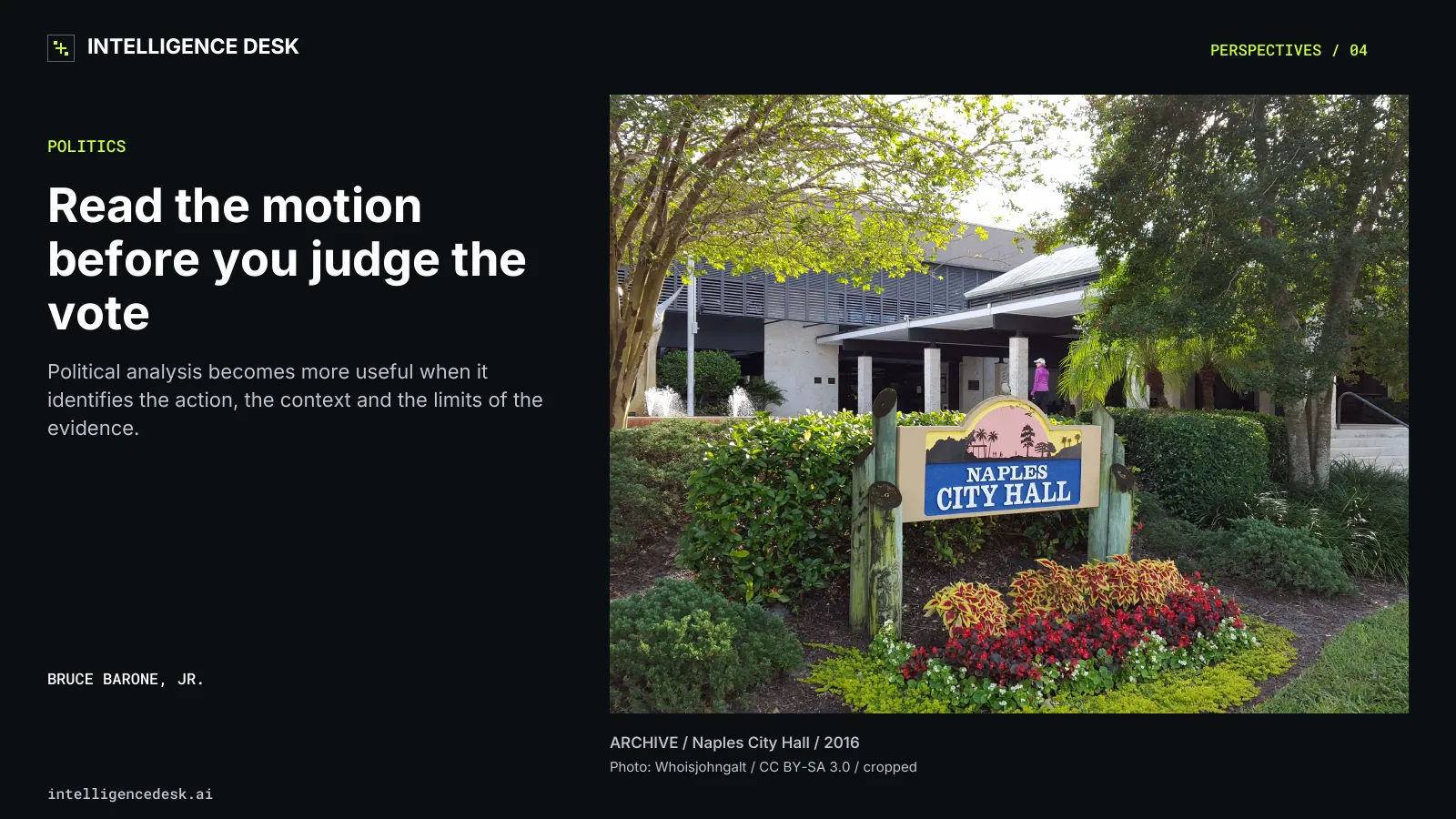
A council member votes yes. The immediate interpretation is that the member supports the project. That may be right. It may also be an incomplete description of a vote to continue a hearing, request a revision or approve one part of a larger proposal. The motion tells the reader what the vote actually did.
For political reporting, the distinction is fundamental. A tally can establish an action without establishing motive. A pattern can be worth investigating without proving coordination. A campaign relationship can be relevant without explaining every subsequent decision. The research becomes stronger when those boundaries are visible.
I want Intelligence Desk’s political work to make public power more legible. That begins with an exact account of the decision: which body acted, what authority it was exercising, which motion was before it and what changed as a result. The interpretation should follow that account closely enough for a reader to test it.
Describe the act before assigning a label
Begin with the agenda, supporting material, meeting record and final instrument where one exists. Record the motion and any amendment that changes its meaning. Identify whether the body made a recommendation, a procedural decision or an operative approval. The same elected officials may act in different public capacities; the body and authority belong in the account.
Florida’s public-meeting statute provides the basic framework for open meetings and promptly recorded minutes available for inspection, subject to applicable exceptions. [1] That record gives the analysis a starting point. A short video excerpt or a secondhand summary should lead back to the complete action and the available supporting documents.
Keep attendance and abstention visible
A missing yes vote is not automatically a no vote.
Under Florida Statutes 286.012, a member present for an official decision generally must vote, and that vote must be recorded. Exceptions cover specified conflicts or possible conflicts, with applicable disclosure requirements, and abstention to assure fairness in a quasi-judicial proceeding. [2] An abstention is therefore an event to document, with its stated basis and relevant disclosure where applicable. Keep it separate from absence and from a vote against the motion. If the basis is missing, identify that gap rather than assume it was lawful or improper.
An analysis that collapses those categories can distort participation and agreement. The reader should see the number of eligible comparisons and the cases left out. If the record does not resolve a category, preserve the uncertainty. A clean-looking chart should not acquire precision by silently discarding an awkward case.
Compare decisions that mean the same thing
An illustrative official might vote to continue a hearing and later vote against the final application. Counting the first vote as support for the project would create a misleading comparison. A second official might support an amended proposal after opposing its original version. The change in the motion is part of the explanation. These are hypothetical examples, not claims about named officials.
Before calculating an approval rate or an alignment rate, define the decisions included. Separate procedural actions from substantive ones, explain the treatment of amendments and identify the observation period. Publish the underlying list. Readers should be able to see whether the apparent pattern depends on the researcher’s selection of cases.
A small set of votes may suggest a question worth pursuing. It rarely carries the same explanatory weight as a sustained pattern across comparable decisions. The article should say what the sample contains and leave broader claims proportionate to that evidence.
Distinguish public reasons from inferred motives
A member’s stated reason is evidence of what the member said. The adopted motion is evidence of the action taken. A researcher may infer a broader priority from a series of decisions, but that inference should be identified and tested against contrary examples. A quotation, an action and an interpretation should remain distinguishable.
That discipline permits sharper criticism. Instead of attributing an unproved motive, the analysis can show a contradiction between an earlier commitment and a later decision, identify a missing explanation or examine who received the benefit of an adopted policy. Where the discrepancy is material, seek a response and publish it fairly.
Make the comparison reproducible
For a council comparison, publish a compact codebook before drawing a political conclusion. Define the issue categories, the difference between procedural and substantive motions, the handling of amended proposals and the rules for missing records. Preserve a link to every included action. A second reader should be able to reconstruct the comparison without accepting the researcher’s judgment on trust.
Then test the result against reasonable alternatives. Does the apparent alignment remain if procedural votes are excluded? Does it depend on a single large project with repeated hearings? Does a shorter observation period reverse the interpretation? These checks do not remove judgment. They show where judgment enters the analysis and whether the conclusion survives a fair challenge. That is particularly important when a small local record is presented in a visually authoritative chart.
Publish the record behind the interpretation
A useful political brief gives readers the meeting date, the body, the motion, the recorded participation and the resulting action. It links the source and explains the method behind any comparison. Corrections should be visible, especially when a revised record changes a conclusion.
Readers can then disagree about the merits while sharing a reliable account of what happened. That is a more productive basis for civic debate than a score that cannot be reconstructed.
Political intelligence should help people understand how decisions are made and where judgment is still required. The method starts with the motion because that is where a general political story becomes a specific public act.
Sources and record notes
- Florida Statutes 286.011 — Florida Legislature.
Subsections (1) and (2): public meetings, reasonable notice and promptly recorded minutes open to inspection; the statute also contains exceptions.
- Florida Statutes 286.012 — Florida Legislature.
Members present generally must vote. Specified conflict or possible-conflict exceptions carry applicable disclosure requirements; quasi-judicial abstention may protect fairness.
Continue the conversation
What decision are you working through?
Bring a civic question, a property decision or a public record that deserves closer examination.
Read freely. Contact details are requested only when you choose to send an inquiry.