The vote is only the beginning
Public projects need a record that follows a promise through funding, contracts and delivery.
Perspectives sets the method. The Naples Decision Files apply it. Read the applied work
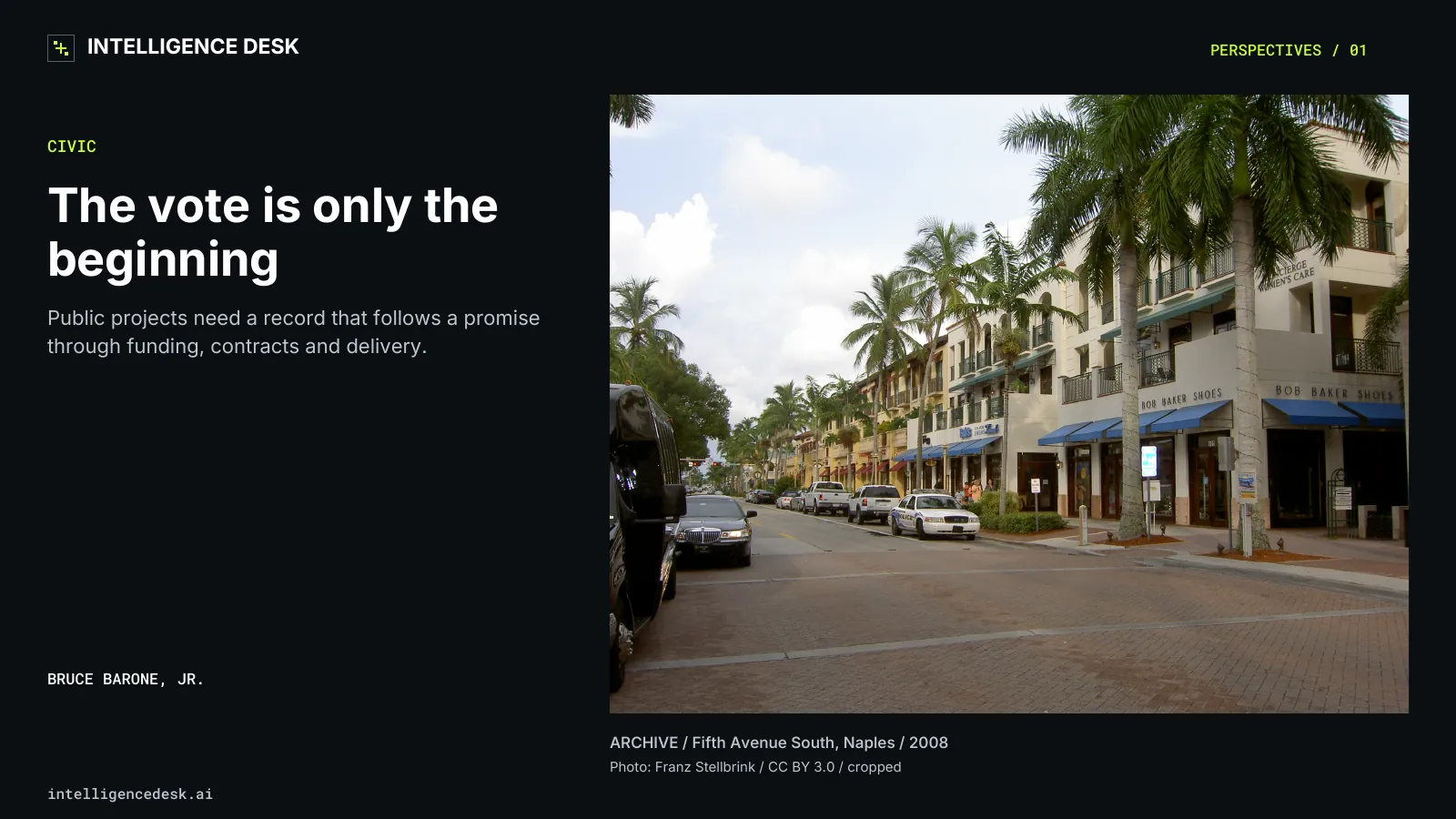
Picture a public project on Fifth Avenue South in Naples. A council approves a streetscape. A district celebrates the investment. A merchant asks when the sidewalk outside the shop will reopen. The example is illustrative, but the three perspectives expose a real reporting gap: they concern the same project and require different answers. The approval establishes a public decision. It does not, by itself, explain the construction schedule, the money still required or the person responsible for the next step.
After serving as executive director of Naples’ Fifth Avenue South Business Improvement District, I approach public investment from the street as well as the meeting room. A project becomes meaningful to a business when access, timing and operating conditions become clear. To a resident, it becomes meaningful when the promised improvement works.
Cities, agencies and districts that sponsor public projects should publish and maintain a simple delivery record: the original commitment, the current scope, the relevant money, the next milestone and the evidence behind each entry. It should survive a change of contractor, a revised budget and an election.
Give every dollar a meaning
Public-project reporting becomes confusing when different kinds of money appear under the same headline. A planning estimate describes an expectation. A budget allocation establishes a spending framework. An executed agreement records an obligation. An invoice requests payment. A payment record documents a disbursement. Each answers a different question.
Florida’s municipal budget statute requires an annual adopted budget and ties municipal expenditures to that budget. That is a useful starting point for accountability, but the budget alone is not evidence that a particular improvement has been delivered. The relevant contracts, amendments and completion records still matter. [1]
A useful project summary therefore labels amounts before comparing them. It identifies the phase, fiscal year and source document. It shows whether an amendment adds to a contract or restates its total. Adding a design award to a construction estimate without explaining their relationship can produce an impressive number and a misleading account.
Connect the schedule to the money
New York City provides a practical example of connecting records. Its Capital Projects Dashboard brings agency project schedules together with budget information from the City’s financial system. It includes project phase and projected completion dates. The City also explains that the budget and schedule information is refreshed three times a year. [2]
The transferable lesson is the relationship between the records. A smaller city can begin with a modest register rather than a major technology purchase. Every project needs a stable identifier, an accountable department, a dated status and the next action. An update date belongs beside the information because a forecast from last quarter may no longer describe the decision in front of a business today.
Explain the change in ordinary language
A revised date should come with an explanation: the scope changed, a utility conflict emerged, a bid exceeded the estimate or an approval remains outstanding. The record should distinguish a documented cause from a working explanation that still needs confirmation. When the cause is unknown, the next inquiry should be explicit.
This also makes criticism more precise. A delay can reflect weak management, an unresolved dependency or a deliberate choice to improve a project. Those possibilities should be tested against the record. Residents can disagree with a decision while still understanding what produced it and who has the authority to move it forward.
Measure the result after opening
Construction completion is an important milestone. A district also needs to understand whether the improvement serves its intended purpose. A parking project can be examined through use, access and operating costs. A streetscape can be examined through maintenance, pedestrian conditions and business access. Define the success measure when the project objective is adopted, then record the baseline before construction begins.
Commercial outcomes require particular care. A change in sales or vacancies can have many causes. A useful evaluation records the starting conditions, the observation period and other changes occurring nearby. It reports what was measured before claiming what the public project caused.
A useful monthly delivery record
For each selected project, preserve the original scope and its dated baseline alongside the current forecast. Record the reason for a material change and link the action that authorized it. Keep a separate field for the next dependency: an easement, design decision, procurement step or construction milestone. A responsible department and a review date make that dependency actionable.
The board’s discussion can then focus on exceptions. Which commitment changed since the last report? Which next action has no responsible party? Which forecast depends on a document that has not been obtained? A register built this way can remain brief because the supporting records are linked. It becomes an institutional memory as well as a meeting document, preserving the difference between what was originally promised and what was later decided.
Make the next decision visible
A downtown board could begin with the handful of commitments that most affect daily life. At each meeting, publish what changed, the document that establishes it and the next responsible party. Keep resolved items in the record so the public can see the full sequence, including the work that succeeded.
This is the kind of civic intelligence I am developing through Intelligence Desk: assembling scattered evidence around a consequential decision and explaining what follows. The public value is practical. A merchant can plan, a resident can evaluate a promise and an official can answer a specific question with a specific record.
The vote starts the obligation to explain. Delivery is where the community discovers what the decision was worth.
Sources and record notes
- Florida Statutes 166.241 — Florida Legislature.
Subsection (2): annual municipal budgets and the relationship between the adopted budget and expenditures.
- NYC Capital Projects Dashboard — City of New York.
Dashboard description: agency schedules, financial-system budgets, project phase and projected completion. Stated update cadence is three times annually.
Continue the conversation
What decision are you working through?
Bring a civic question, a property decision or a public record that deserves closer examination.
Read freely. Contact details are requested only when you choose to send an inquiry.